The Calorie Calculator That Finally Understands Indian Food
Indian Food Calorie Calculator: Count Calories the Desi Way
No more guessing what a katori of dal "roughly" costs you — search, tap, and see the real number.
618+ Indian foods, real household unitsEvery calorie counting app you've tried was built for a plate of grilled chicken and broccoli. The moment you try to log "1 katori chole" or "2 tawa parathas with ghee," it either doesn't exist in the database or gets logged as some random American approximation. That gap is exactly why we built the Indian Food Calorie Calculator — a tool that speaks the language of an Indian kitchen: katori, roti, cup, glass.
Why Indian food breaks most calorie apps
Indian home cooking doesn't come with a nutrition label. A "katori of dal" can be watery toor dal or a ghee-loaded dal makhani, and the calorie gap between the two is massive. Most trackers force you to search in grams — which nobody weighs at home — or pick the closest "Indian curry" match and hope for the best. Over weeks, that guesswork is often the real reason a fat loss or muscle gain plan stalls, not effort, just untracked calories quietly adding up.
What the calculator actually does
- Search dal, roti, rice, paneer, chicken, fish, fruits, salads and more — 618+ foods and counting
- Pick the unit you actually eat in: katori, roti, cup, piece or plain grams
- Get calories plus full macros — protein, carbs, fat, fibre, sugar
- See key micronutrients too — sodium, calcium, iron, potassium, vitamin C
- Stack multiple items to total up an entire meal, not just one food
The nutrition data isn't a random guess either — it's pulled from the Indian Nutrient Databank (INDB), the Indian Food Composition Tables 2017 (ICMR's National Institute of Nutrition), and USDA FoodData Central for the handful of items that need it. That's the same data serious dietitians reference, just in a search bar instead of a research paper.
How to use it in under a minute
- Step 1: Open the calorie calculator and search for a food — e.g. "roti," "chole," "chicken curry"
- Step 2: Choose your serving unit and quantity — 2 rotis, 1 katori, 150 g, whatever matches your plate
- Step 3: Add every item on your plate the same way
- Step 4: Read off the total calories, protein, carbs, fat, fibre and sugar for the whole meal
A real thali, calculated out
Here's what a fairly standard Indian lunch works out to, item by item:
| Food | Serving | Calories | Protein |
|---|---|---|---|
| Roti / Chapati (x2) | 2 roti (80 g) | 238 kcal | 7.2 g |
| Dal Tadka | 1 katori (150 g) | 218 kcal | 9 g |
| Mixed Vegetable Sabzi | 1 katori (150 g) | 173 kcal | 4.5 g |
| White Rice (cooked) | 1 katori (150 g) | 195 kcal | 4.1 g |
| Curd / Dahi | 1 katori (150 g) | 90 kcal | 4.7 g |
| Total | 914 kcal | ~29.5 g | |
That's a complete, filling North Indian thali sitting at just under 1000 calories with close to 30 g of protein — logged in the exact units you'd actually serve it in, no scale required.
Nutrition tracking is step one, not the whole plan
A calculator tells you what you're eating. It doesn't tell you what you should be eating — that depends on your age, weight, activity level and goal. If you're tracking your meals but still not seeing progress, the missing piece is usually a target, not more discipline. Worth also getting your basics right on the supplement side — fish oil is one of the few that's actually backed by evidence, unlike most of what gets sold as a "fat loss shortcut" — see the truth about liposuction for why those rarely hold up long-term compared to consistent tracking and training.
Getting your calories right also matters for more than the mirror. Chronic overeating and excess body fat feed straight into cardiovascular risk — heart attack and cardiac arrest are not the same thing, but consistent, tracked nutrition protects you against both. And if your weight isn't moving despite the numbers adding up, don't rule out the hormonal side — issues like high testosterone in women or high estrogen in men can quietly stall progress no calculator alone will explain. For more science-backed breakdowns like these, browse the full Coach Himanshu blog.
Sources referenced: Indian Nutrient Databank (INDB), Anuvaad Solutions / Jaacks Lab (used under CC BY), Indian Food Composition Tables 2017 (ICMR-NIN), and USDA FoodData Central.
Know your calories. Now get your target.
A free assessment turns this calculator into an actual Indian diet and workout plan built around your body, routine and goal.
Related Articles
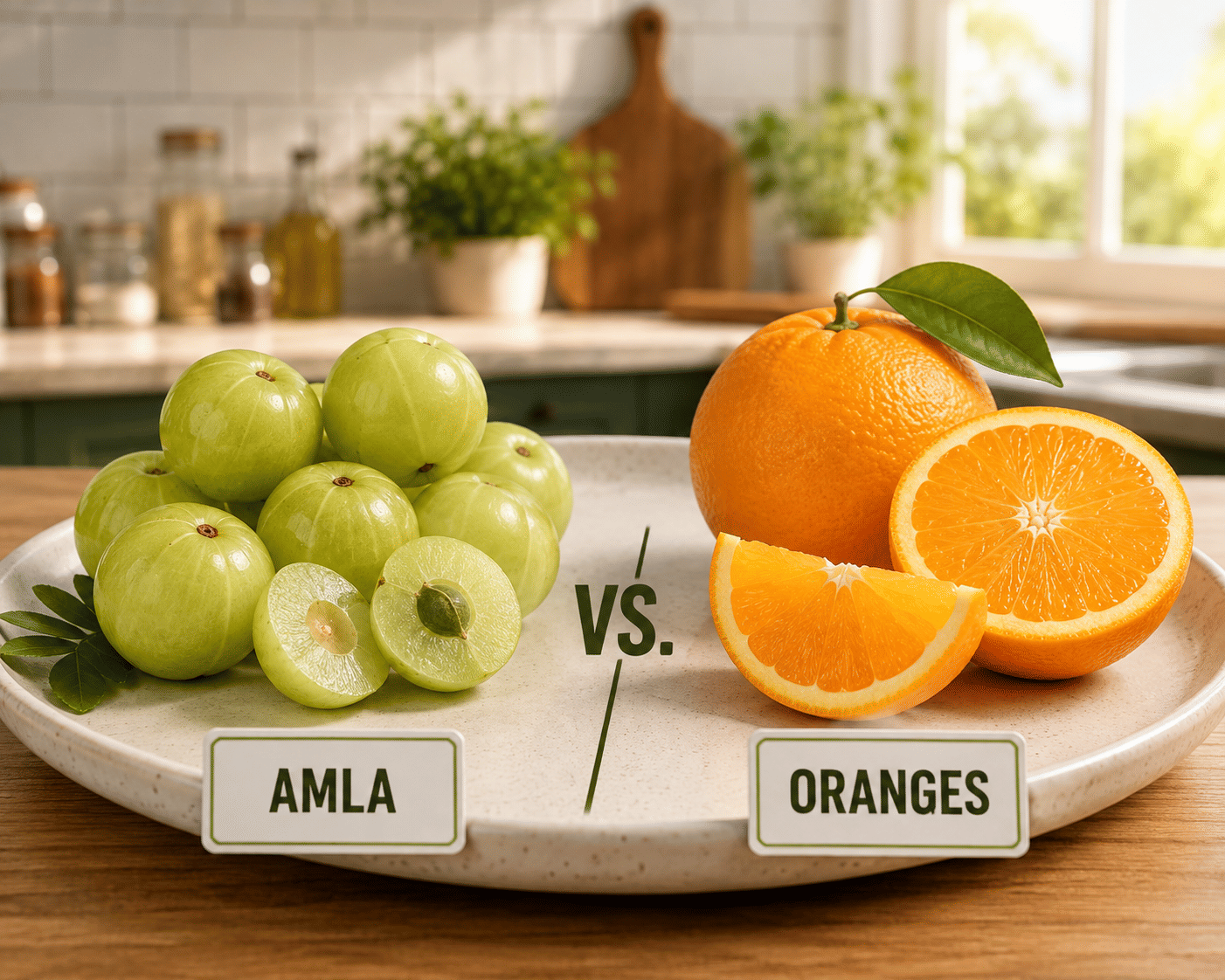
Amla vs Orange: The Real Vitamin C Rankings for Indian Diets
This blog explains what vitamin C really does in the body, how much you actually need, and which Indian foods give you the most of it — spoiler: amla and guava beat oranges by far. It clears up common myths, like the idea that taking huge doses prevents colds, using a simple color-coded myth vs. fact section. It also covers who might need a bit more vitamin C (like smokers), how much is too much, and why food sources are better than relying on serums or supplements alone.

Your Heart Can Fail Two Ways — Here's the Difference
Most people use "heart attack" and "cardiac arrest" as if they mean the same thing — they don't. A heart attack is a circulation problem caused by a blocked artery, while cardiac arrest is an electrical malfunction that stops the heart from beating altogether. This blog breaks down the real difference, how one can trigger the other, and why knowing this could change how you respond in an emergency. It also connects the science back to everyday nutrition and training, showing how consistent diet and exercise habits help protect your heart long-term.

Muscle Confusion Is a Myth: Why Progressive Overload Actually Builds Muscle
Muscles respond to mechanical tension, training volume, and progressive overload—not novelty or being “shocked.” Progressive overload means gradually increasing weight, reps, sets, or improving performance over time. Constantly changing exercises can make it harder to track progress and improve technique. Exercise variation still has a place for managing joint stress, breaking genuine plateaus, and improving adherence. The key is simple: follow a structured program, track your progress, and progressively make training harder.
Ready to Start Your Fitness Journey?
Get personalized training and nutrition guidance from Coach Himanshu
Explore Plans