Desk Job Posture: How to Reduce Back Pain, Rounded Shoulders and Hip Stiffness

The Desk Job Body: Why Long Sitting Hurts Your Back, Shoulders and Hips — And How to Undo It
Back pain, rounded shoulders, hunchback, anterior pelvic tilt — what actually causes them, what the research says, and how to fix them.
Heads pushed forward, shoulders rolled in, lower backs either flattened into the chair or arched hard when standing — that's the desk-worker look. The usual advice is "sit up straight." The honest version is more useful: your body adapts to what you do most, and a desk job asks it to do very little, in one position, for hours. Fix that and most problems improve. Start with your real baseline too — the Indian Food Calorie Calculator beats guessing.
What 8–10 hours of sitting does to your body
- Hip flexors stay shortened and feel tight when you stand.
- Glutes and deep core barely work, losing strength relative to muscles that stay on.
- Chest and front shoulders stay short; mid-back muscles are stretched and under-used.
- The neck holds the head forward of the shoulders all day.
- Spinal tissues sit under sustained load in one position — you feel it after long unbroken stretches.
The honest science: is posture really the villain?
Most posture content oversells. A 2019 JOSPT paper ("Sit up straight: time to re-evaluate") found no strong evidence that one "correct" posture exists or that avoiding "incorrect" ones prevents low back pain. A 2020 umbrella review of 41 systematic reviews found mixed results too. The most consistent theme is that inactivity and long static loading matter more than exact spinal angle.
So some forward head, rounding and pelvic tilt is normal variation. But if you have stiffness or pain and sit all day with weak supporting muscles, posture-related strength work is still sensible and low-risk. We treat these patterns as training targets, not diagnoses.
The 5 desk-job problems
1. Lower back pain
Ache or stiffness after long sitting.Tight: hip flexors, low-back muscles
Weak: glutes, deep abs, back extensors
2. Rounded shoulders
Shoulders sit forward; palms face back at rest.Tight: chest, front shoulders
Weak: mid/lower traps, rhomboids, serratus
3. Forward head
Ear sits ahead of the shoulder line.Tight: upper traps, neck extensors
Weak: deep neck flexors
4. Hunchback
Increased upper-back curve (thoracic kyphosis).Tight: chest, stiff mid-back
Weak: upper-back extensors, lower traps
5. Anterior pelvic tilt
Pelvis tips forward, low back arches, glutes look prominent.Tight: hip flexors, low back
Weak: glutes, abs, hamstrings
- These "crossed syndrome" patterns are clinical frameworks, not proven laws — bodies vary, so assessment beats templates.
- Some anterior pelvic tilt is completely normal.
- Hunchback is either postural (flexible, improves with training) or structural (rigid, needs a doctor).
- The "text neck adds 27 kg" figure is a modelled estimate, not a measurement. Holding your head forward for hours is still real strain.
Quick self-check (not a diagnosis)
- Wall test: Back to a wall, heels a few cm out. Can your glutes, shoulder blades and the back of your head touch it without chin-lifting? A gap bigger than about a hand behind your lower back may mean an exaggerated arch.
- Side photo: Is your ear far ahead of your shoulder, or your pelvis visibly tipped forward?
- Overhead reach: Raise both arms overhead against a wall without your lower back arching or ribs flaring. If you can't, chest, lats and mid-back are likely stiff.
How to fix it: the 4-part plan
1. Move more — the biggest lever
- Interrupt sitting every 30–60 minutes with 1–3 minutes of standing or walking. No magic interval; the principle is breaking up unbroken sitting.
- Walk daily — benefits show across roughly 7,000–10,000 steps.
- Meet the WHO guideline: 150–300 minutes moderate activity a week plus strength work on 2+ days.
- A 2016 Lancet meta-analysis of over a million people found ~60–75 minutes of moderate daily activity offset the extra mortality risk of high sitting time (observational, not a promise).
2. Strengthen what sitting switches off — the real fix
Train 2–3 days a week and progress the load — the same logic as progressive overload.
| Exercise | Targets | Start with |
|---|---|---|
| Seated / chest-supported row | Mid-back, rhomboids | 3 × 8–12 |
| Face pull / band pull-apart | Rear shoulders, lower traps | 3 × 12–15 |
| Wall slide | Serratus, lower traps | 2 × 10–12 |
| Chin tuck | Deep neck flexors | 2 × 10, 5-sec hold |
| Glute bridge → hip thrust | Glutes (APT, low back) | 3 × 8–12 |
| Romanian deadlift | Glutes, hamstrings, back | 3 × 8–10 |
| Dead bug / bird dog | Deep core, trunk control | 2–3 × 6–10 per side |
| Side plank | Lateral trunk | 2–3 × 20–30 sec per side |
Leave 1–3 reps in reserve with clean form. Mild soreness is normal; sharp or pinching pain is not — modify or stop.
3. Mobilise what sitting tightens — 5–10 min daily
- Half-kneeling hip flexor stretch — tuck pelvis, squeeze glute, 2 × 30–45 sec per side.
- Doorway pec stretch — 2 × 30–45 sec per side.
- Thoracic extension over a foam roller or bench edge — 1–2 × 8–10 slow reps.
- Cat–cow or open-book rotation — 1–2 × 8–10.
4. Set up your desk — support, not solution
- Screen at or slightly below eye level, about arm's length away. Laptop? Add a stand, external keyboard and mouse.
- Chair: feet flat (footrest if needed), back supported, forearms resting near elbow height.
- Vary your position. The best posture is your next posture.
- Sit-stand desks cut workplace sitting by about 100 minutes a day short-term in a 2018 Cochrane review (low-quality evidence, no proven long-term health benefit). Standing still all day isn't the answer either.
What to avoid
- Sitting "perfectly straight" for hours — still static.
- Bed rest for back pain — guidance such as NICE recommends staying active.
- Posture-corrector braces as the fix — a reminder at best, no strength built.
- Stretching only, with no strengthening.
- Fear of movement — your spine is robust and adapts to gradual loading.
Prevention: the desk-worker routine
Every 30–60 min
Stand, walk 1–2 min, 5–10 shoulder blade squeezes, a few chin tucks.Lunch
10–15 minute walk. Take calls standing when you can.After work
5–10 min mobility, or a strength session on training days.Weekend
Longer walks, sport — anything that isn't sitting.Beyond posture: excess body weight is linked to higher low-back-pain risk; protein of roughly 1.6–2.2 g/kg supports training (check with a doctor if you have kidney disease); vitamin D is worth testing, supplementing only if deficient; and poor sleep and high stress amplify pain. Stiff joints too? Read why joints take months, not weeks, to heal.
How long will it take?
2–4 weeks
Less stiffness, easier sitting tolerance, better control.6–12 weeks
Noticeable strength gains and posture you hold without effort.Long term
Exercise-based programmes are linked to fewer back-pain recurrences (JAMA Intern Med 2016) — while you keep doing them.Realistic expectation: a flexible postural curve can improve noticeably; a structural curve won't straighten with exercise alone.
Myth vs fact: desk-job edition
When to see a doctor
- Back pain after a fall, accident or injury
- Numbness, tingling or leg weakness, or pain spreading below the knee
- Loss of bladder or bowel control, or numbness around the groin (emergency)
- Fever, or pain worse at night or at rest
- A rigid, painful or rapidly worsening upper-back curve, especially if older, post-menopausal or with past fractures
- Pain not improving after several weeks, or getting worse
How Coach Himanshu helps desk workers
- A movement and posture assessment to find your pattern, not a template.
- Strength programming for glutes, mid-back, deep core and neck via 1:1 online personal training.
- Five-minute desk-break routines that fit between meetings.
- Indian-food nutrition and protein targets using your calorie numbers.
- Credentials you can check — see what NASM certification means for your coach.
Explore coaching for working professionals.
Disclaimer: Educational and general; not individualised medical advice. With persistent pain, a diagnosed spinal condition, osteoporosis or any red flag above, consult a doctor or physiotherapist before starting a new programme.
Sources referenced: WHO Guidelines on Physical Activity and Sedentary Behaviour (2020); Ekelund et al., The Lancet (2016); Slater et al., JOSPT (2019); J Biomech (2020) umbrella review on posture and low back pain; Cochrane reviews on workplace sitting (2018) and exercise for chronic low back pain (2021); Steffens et al., JAMA Intern Med (2016); NICE NG59.
Undo the desk-job damage — with a plan built for your body
Strength, mobility and nutrition designed around your job, schedule and pain points — not a generic template.
See Coaching PlansJoin Fit Bharat MissionRelated Articles

Navratri Vrat Without the Guesswork: Rules, Body Science and Workouts
Navratri fasting varies by family, region and community, so this blog lays out the vrat rules as commonly followed rather than as one fixed rulebook. It explains the main types of fast (full vrat, first-and-last-day, phalahar, one meal a day, nirjala) and who each suits physiologically. It covers what fasting does inside the body, both the benefits and the risks. It exposes vrat-food traps like sabudana and fried snacks, and busts myths about detox, sendha namak and weight loss. It then gives practical workout guidance for each fast type, plus warning signs for when to stop and see a doctor.
The Avascular Truth: Why Your Joints Take Months, Not Weeks, to Heal
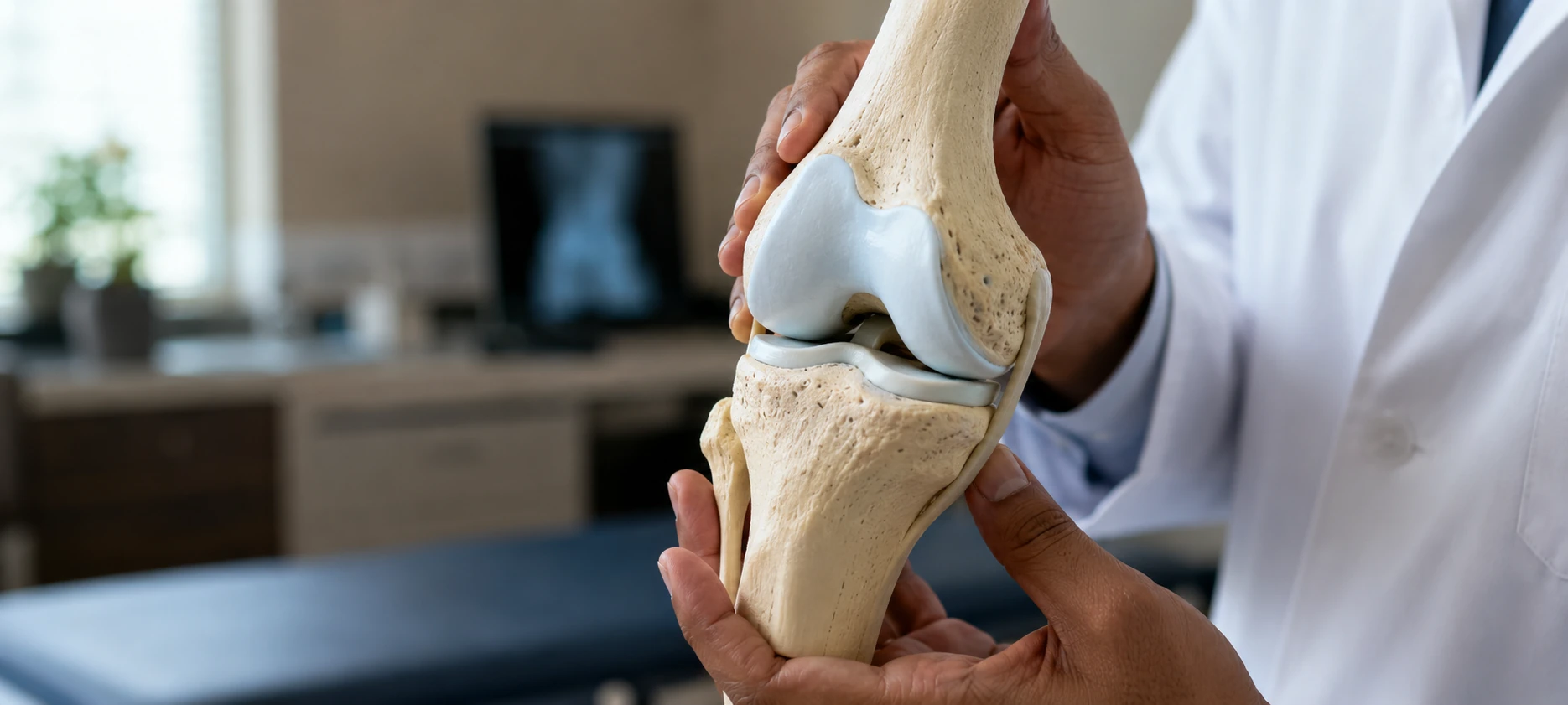
Cartilage has almost no blood supply, so unlike muscle or skin it can't call in oxygen, nutrients, or repair cells fast — it relies on slow diffusion from joint fluid instead. This blog explains why that makes cartilage damage (like meniscus tears or worn knee cartilage) take months to partially heal, and sometimes never fully recover to its original quality. It covers what actually damages cartilage, the warning signs that mean "adjust training" rather than "push through," and busts common myths around joint cracking and glucosamine supplements. It closes with how Coach Himanshu builds training plans that protect joint longevity while still progressing strength and performance.

Fatty Liver Isn't Just an Alcohol Problem Anymore — Here's What It Actually Is
Fatty liver — alcoholic or non-alcoholic — is one of the most common findings on routine scans today, and one of the most misunderstood. This blog breaks down what it actually is, the difference between AFLD and NAFLD, why it happens, and the stage-by-stage question everyone actually wants answered: is it reversible? It covers exactly how diet and exercise reverse early-stage fatty liver, clears up common myths (thin people can't get it, detox teas cure it, symptoms are always obvious), and ends with how Coach Himanshu builds a fatty-liver-friendly diet and training plan around your real numbers.
Ready to Start Your Fitness Journey?
Get personalized training and nutrition guidance from Coach Himanshu
Explore Plans